
How a Digital Twin Enhances Plant Safety
In the oil & gas and petrochemical industries, safety is not only about procedures and compliance. It is also about having accurate, connected, and accessible information that helps teams make the right decisions at the right time.
These facilities are complex by nature. They involve hazardous materials, high-risk operations, safety-critical equipment, and continuous modifications over long periods of time. In many cases, especially in brownfield environments, plant information is spread across outdated drawings, disconnected systems, spreadsheets, legacy documents, and individual team knowledge. This creates gaps that can directly affect safety.
A Digital Twin helps solve this challenge by integrating engineering data, 3D models, documents, and related systems into a single digital environment. It gives teams a clearer understanding of the plant and makes safety-related information easier to access, verify, and use.
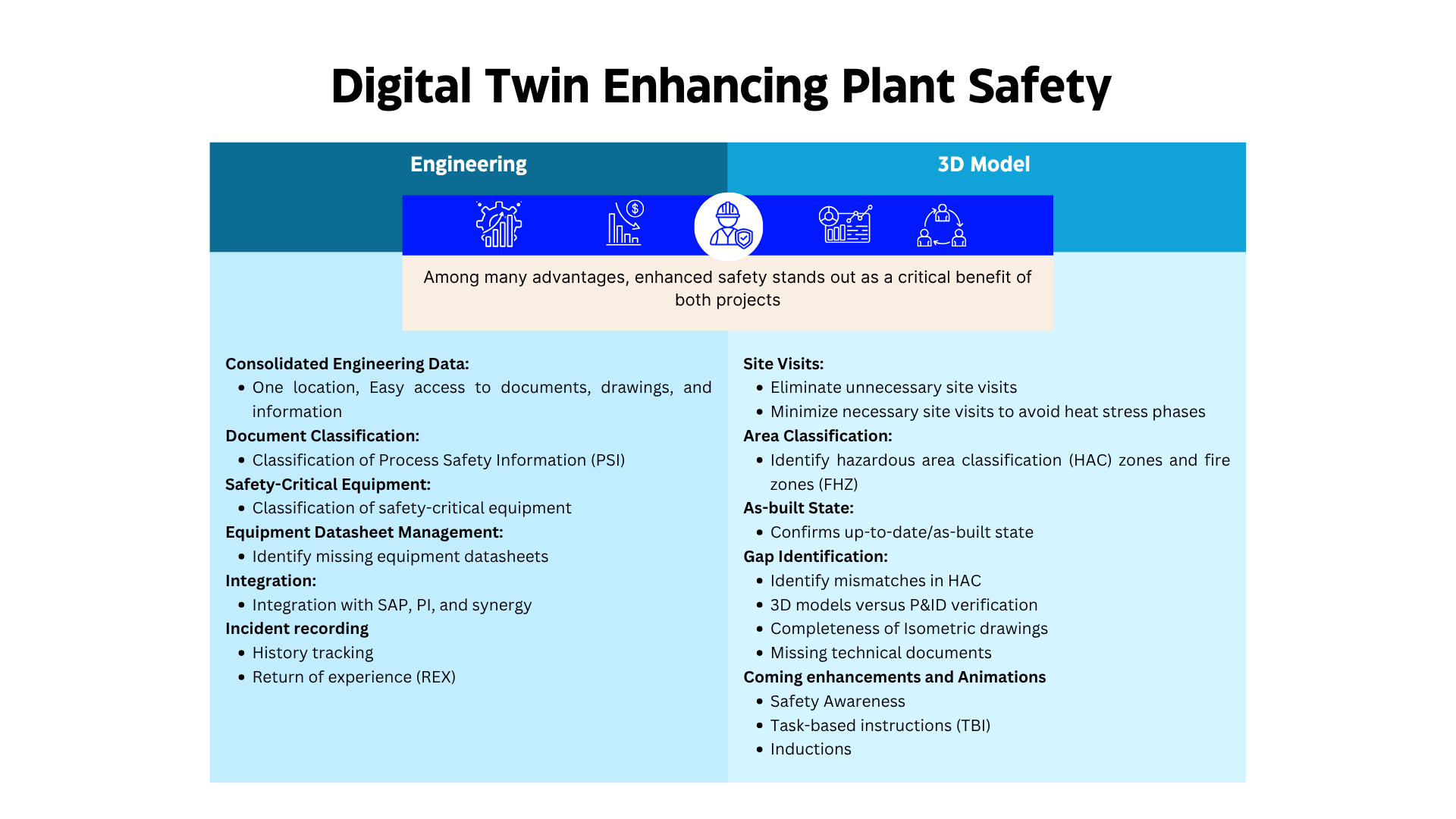
Among many advantages, enhanced safety stands out as a critical benefit of both engineering data and 3D model environments.
HAC and FHZ Area Classification
One of the most important safety benefits of a Digital Twin is the ability to visualize Hazardous Area Classification (HAC) and Fire Hazard Zones (FHZ) directly within the 3D environment.
Instead of relying only on separate documents, 2D drawings, or static reports, users can see the classified zones visually on the 3D model itself. This makes it easier to understand exactly where hazardous and fire-risk areas are located, how far they extend, and how they relate to equipment, access routes, work areas, and surrounding plant conditions.
This visual context is especially important in oil & gas and petrochemical facilities, where teams need to understand whether a certain area falls under a specific safety classification before performing work, planning modifications, or reviewing equipment placement.
By showing HAC and FHZ directly in the Digital Twin, the system helps teams:
Identify hazardous and fire-risk areas more clearly
understand the extent of each zone in relation to plant equipment
support safer planning before site visits or field work
Verify whether modifications or installations fall within critical zones
improve safety awareness across engineering, operations, and HSE teams
Consolidated Engineering Data
One of the main safety benefits of a Digital Twin is the consolidation of engineering data. In traditional environments, teams may need to check multiple sources to understand the status of one asset: P&IDs, equipment datasheets, vendor documents, tag lists, inspection records, SAP, PI, or other systems. When these sources are not aligned, the risk of using outdated or incorrect information increases.
With a Digital Twin, engineering data can be connected and structured around the asset. This gives teams easier access to documents, drawings, equipment details, and process information from one location. This supports safer decision-making because users are not only viewing information, they are accessing validated and connected data.
Supporting Process Safety Information Classification
Process Safety Information, or PSI, is essential for safe plant operation. It includes the information needed to understand process hazards, equipment design, safe operating limits, and protection systems.
A Digital Twin helps classify and organize PSI by linking the required documents and data to the relevant assets and systems. This makes it easier for teams to identify what information exists, what is missing, and what needs to be updated.
For oil & gas and petrochemical plants, this is especially important because safety decisions often depend on the accuracy of engineering information. When PSI is structured and accessible, teams can respond faster and with more confidence.
Identifying Safety-Critical Equipment
Not all equipment carries the same level of risk. Some assets are safety-critical because their failure could impact people, the environment, or plant operation.
A Digital Twin helps classify safety-critical equipment and connect it to the required documentation, datasheets, inspection records, and operating context. This makes it easier for engineering, maintenance, and HSE teams to understand which assets require closer attention.
It also supports better prioritization. Instead of treating all missing or outdated data equally, teams can focus first on the assets with the greatest safety impact.
Improving Equipment Datasheet Management
Missing or outdated equipment datasheets are a common challenge in brownfield facilities. This becomes a safety concern when teams cannot confirm design limits, operating parameters, materials, pressure ratings, or equipment specifications.
Through a Digital Twin, missing equipment datasheets can be identified and linked to the relevant equipment in the 3D model and engineering database.
This helps teams close information gaps and improve the quality of safety-critical asset information.
Integration with Operational systems
A Digital Twin becomes more powerful when it is integrated with systems such as SAP, PI, and incident management platforms. This integration allows teams to move from static engineering data to connected operational intelligence. For example, an asset in the 3D model can be linked to maintenance history, performance data, inspection records, or incident information.
This gives teams a clearer view of the asset’s condition and history, helping them make safer and more informed decisions.
Incident recording
A Digital Twin can also strengthen safety by tracking history and lessons learned from previous incidents.
By linking incident-related information back to assets, systems, or plant areas, teams can improve traceability and use past experience to reduce future risk. This helps organizations move from reactive response to continuous safety improvement.
In oil & gas and petrochemical environments, where operational knowledge is extremely valuable, tracking incidents and capturing lessons learned can help prevent repeated issues and improve long-term safety performance.
Reducing Unnecessary Site Visits
A 3D Digital Twin can significantly improve the way teams prepare for field activities.
One of its safety benefits is helping eliminate unnecessary site visits and minimizing necessary ones. Instead of going physically to the plant for every check, review, or clarification, users can first explore the area digitally.
This is especially useful in large industrial sites or in regions where environmental conditions can pose additional risks, such as high temperatures or difficult access.
By reducing unnecessary exposure and improving preparation before going on site, the Digital Twin contributes directly to safer working practices.
As-built State of the plant
In brownfield plants, one of the biggest risks is the gap between documented information and the facility's actual physical condition.
A Digital Twin helps address this by confirming up-to-date. Through validated engineering data, 3D modeling, and plant verification, teams can work with a representation that more accurately reflects reality.
This is extremely important for safety because decisions made on outdated information can lead to errors during maintenance, modifications, inspections, or shutdown planning.
A more accurate as-built state reduces uncertainty and supports safer execution.
Gap Identification
A Digital Twin also helps identify gaps across engineering and safety data.
These gaps can include mismatches in HAC information, differences between the 3D model and P&IDs, incomplete isometric drawings, missing technical documents, or outdated equipment records.
By identifying these issues early, teams can correct them before they affect maintenance, operations, modification projects, or safety reviews.
In this way, the Digital Twin supports proactive safety management. It helps teams find problems before they become operational risks.
Safety Awareness, Training, and Task-Based Instructions
Beyond engineering and operations, Digital Twins can also support safety awareness and training.
3D models can be used to create safety animations, task-based instructions, and induction materials for employees, contractors, and site visitors.
This is especially useful in complex plants where understanding the environment visually can improve awareness before entering the site.
For example, teams can use the 3D model to explain hazardous zones, access routes, emergency areas, equipment locations, and safe work procedures.
This makes safety communication more practical and easier to understand.
Conclusion
In oil & gas and petrochemical industries, safety is closely linked to the quality and accessibility of information.
A Digital Twin enhances plant safety by making critical information visible, connected, and easier to use. From Area Classification and Consolidated Engineering Data to Gap Identification and Coming enhancements and Animations, it helps teams reduce uncertainty, improve awareness, and make safer decisions across the plant lifecycle.
It is not only a 3D model, and not only a document repository. It is a connected digital environment that allows engineering, operations, maintenance, and HSE teams to work with better clarity and confidence.
For brownfield facilities in particular, where outdated information and disconnected systems are common, the Digital Twin becomes a practical step toward safer operations and more reliable plant management.